Houston County
About
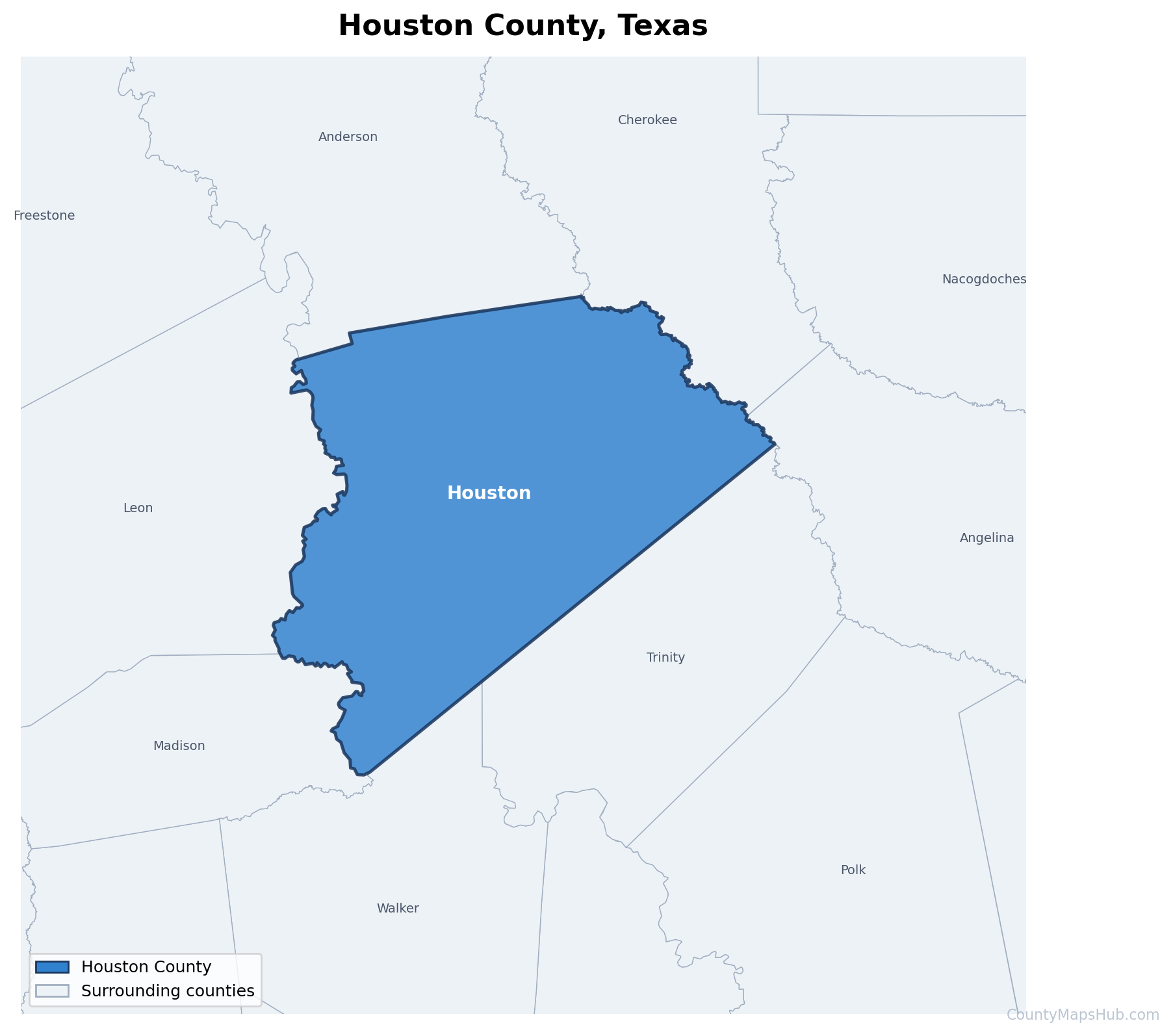
Houston County was established in 1837, making it one of the original counties formed during the early years of the Republic of Texas. The county was named after Sam Houston, the celebrated military leader who served as President of the Republic of Texas and later as Governor of the state. Houston’s legacy as a key figure in Texas independence and statehood made him a natural choice for this honor during a period of rapid territorial organization.
The county seat is located in Crockett, which has served as the administrative and commercial center since the county’s founding. Throughout the nineteenth and twentieth centuries, the region developed an economy based on agriculture, timber, and natural resources. The county’s position in East Texas placed it within a broader network of communities that contributed to the state’s growth during periods of expansion, economic development, and demographic change.
Population
According to the 2020 Census, Houston County had a population of 22,066 residents. This population is distributed across approximately 1,231 square miles, resulting in a relatively low population density characteristic of many rural East Texas counties. The demographic composition reflects the broader patterns of rural Texas communities, with a mix of long-established families and newer residents attracted by the region’s affordability and quality of life. Population trends in the county have remained relatively stable in recent decades, maintaining its character as a predominantly rural area with close-knit communities and a slower pace of life compared to the state’s major metropolitan regions.
Climate
Houston County experiences a humid subtropical climate, typical of East Texas and the broader Gulf Coast region. This climate pattern brings hot, humid summers with temperatures frequently reaching the 90s Fahrenheit, while winters are generally mild with occasional cold fronts that can bring brief periods of cooler weather. Precipitation is distributed fairly evenly throughout the year, with spring and fall often seeing the heaviest rainfall.
The humid subtropical conditions support lush vegetation and dense forests that characterize much of the county’s landscape. The growing season is long, which historically supported agricultural activities. Residents and visitors should be prepared for high humidity levels during the warmer months and the possibility of severe weather, including thunderstorms and occasional tropical systems that can affect East Texas during hurricane season.
Tourist Attractions
Houston County offers visitors a glimpse into rural East Texas life and natural beauty. The region features opportunities for outdoor recreation, including fishing, hiking, and wildlife observation in the area’s forests and waterways. The natural landscape is characterized by pine and hardwood forests typical of the Piney Woods region, providing scenic drives and nature experiences for those seeking to explore the countryside.
The county seat provides historical architecture and small-town charm, with local museums and heritage sites that preserve the area’s past. Visitors interested in regional history can explore exhibits and landmarks that tell the story of early Texas settlement and development. The slower pace and authentic rural atmosphere appeal to travelers looking to experience traditional Texas communities away from urban centers. Seasonal events and local festivals throughout the year celebrate the county’s heritage and provide opportunities to engage with local culture and traditions.
Culture
The cultural fabric of Houston County reflects its Deep South and East Texas heritage, blending traditions that date back to the area’s settlement in the nineteenth century. The community maintains strong ties to its agricultural and timber industry roots, with many families having lived in the region for generations. This continuity has preserved cultural practices, culinary traditions, and social customs that define rural East Texas life.
Local culture emphasizes community connections, with churches, civic organizations, and school events serving as central gathering points for residents. Traditional Southern hospitality is evident in daily interactions, and regional cuisine features comfort foods with influences from Southern and Texas cooking traditions. The county’s cultural identity is also shaped by its connection to Texas history, particularly through its association with Sam Houston and the early Republic era. While the region has evolved over time, it maintains a distinct character that honors its past while adapting to contemporary life in rural Texas.