Leon County
About
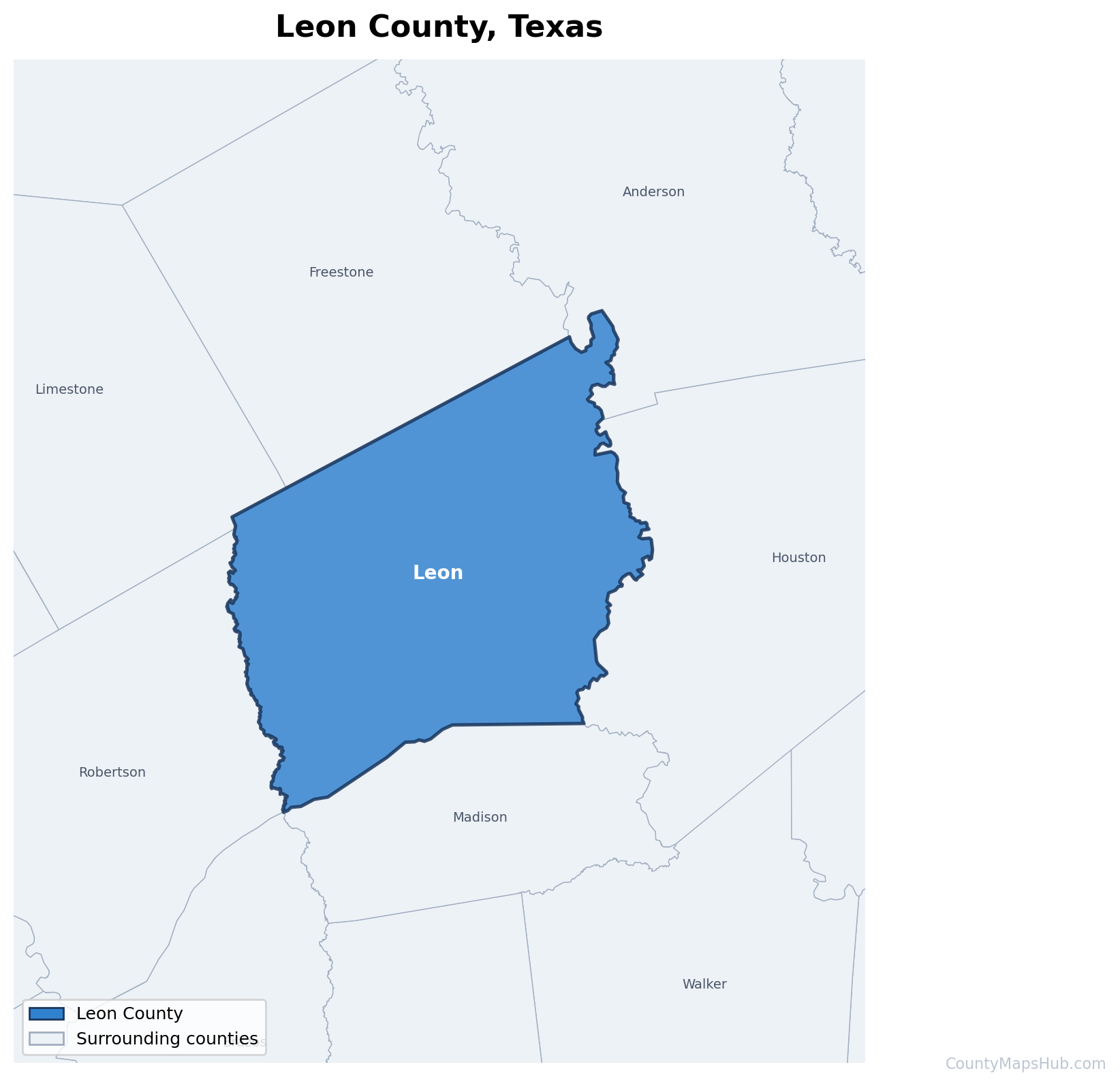
Leon County was established in 1846, carved from Robertson County during a period of rapid expansion in central Texas. The county was named after Martin De Leon, an empresario who played a significant role in the colonization of Texas during the Mexican period. De Leon was one of only two Mexican empresarios to successfully establish a colony, founding the town of Victoria and bringing numerous families to settle in the region.
The county seat of Centerville was established to serve as the administrative and commercial center for the growing agricultural community. Throughout the nineteenth century, the county developed primarily as a farming region, with settlers cultivating cotton, corn, and raising livestock. The arrival of railroads in neighboring counties influenced trade patterns, though the area maintained its predominantly rural character. The county’s development reflected broader patterns of settlement in east-central Texas, where small family farms and timber operations formed the economic backbone of local communities.
Leon County experienced the typical challenges and transformations of rural Texas counties through the twentieth century, including the Great Depression, mechanization of agriculture, and gradual population shifts. The discovery of oil and natural gas in various parts of Texas affected the regional economy, though agriculture remained central to the county’s identity. Today, the county preserves its historical heritage while adapting to modern economic realities in central Texas.
Population
According to the 2020 Census, Leon County had a population of 15,719 residents spread across its 1,078 square miles of territory. This relatively modest population density reflects the county’s continued rural character, with much of the land devoted to agricultural uses, timber production, and open spaces. The population is distributed among small communities and unincorporated areas throughout the county, with Centerville serving as the county seat and primary governmental center. Population trends in the county have generally reflected broader patterns seen in rural Texas counties, with gradual changes influenced by economic opportunities, land use patterns, and migration between urban and rural areas.
Climate
Leon County experiences a humid subtropical climate characterized by hot summers and mild winters, typical of the east-central Texas region. Summer temperatures regularly climb into the 90s Fahrenheit, with high humidity levels making conditions feel even warmer. The region receives moderate to abundant rainfall distributed throughout the year, though late spring and early fall often see the heaviest precipitation. Thunderstorms are common during the warmer months, occasionally bringing heavy downpours and strong winds.
Winters are generally mild compared to northern states, with occasional cold fronts bringing brief periods of freezing temperatures. Snowfall is rare and typically light when it does occur. The transitional seasons of spring and fall offer pleasant weather conditions, with spring particularly noted for wildflower displays common throughout central Texas. The climate supports a diverse range of vegetation, including mixed pine and hardwood forests, grasslands, and riparian zones along the county’s waterways.
Tourist Attractions
Leon County offers visitors opportunities to experience the natural beauty and rural character of central Texas. The area features opportunities for outdoor recreation including fishing, hunting, and wildlife observation in the region’s forests, lakes, and streams. The landscape includes a mix of wooded areas and open countryside that provide habitat for white-tailed deer, wild turkeys, and various bird species, making it attractive to nature enthusiasts and sportsmen alike.
Visitors interested in Texas history can explore the heritage of central Texas settlement patterns and learn about the region’s development from frontier territory to established agricultural community. The county’s rural roads offer scenic drives through classic Texas countryside, with opportunities to observe traditional ranching and farming operations. Local events throughout the year celebrate the area’s agricultural heritage and community traditions, providing authentic glimpses into small-town Texas life. The county’s proximity to larger regional centers allows visitors to enjoy peaceful rural settings while maintaining access to additional amenities and attractions in the surrounding area.
Culture
Leon County embodies the cultural traditions of rural central Texas, where community ties, agricultural heritage, and regional pride form the foundation of local identity. The area reflects a blend of influences from early Anglo-American settlers, with some Hispanic and African American cultural contributions that have shaped the region over generations. Community gatherings, church activities, and local celebrations serve as important social touchstones, reinforcing connections among residents and preserving traditions passed down through families.
The cultural landscape emphasizes values common to rural Texas communities: self-reliance, neighborliness, and strong connections to the land. Agricultural practices and seasonal rhythms continue to influence the local way of life, even as the economy has diversified. Traditional Texas foodways, including barbecue and home-style cooking, remain important aspects of social life, often featured at community events and family gatherings. High school sports, particularly football, serve as focal points for community pride and social interaction, a pattern seen throughout small-town Texas. The county maintains its distinct rural character while participating in the broader cultural currents of the Lone Star State.