Loving County
About
Loving County was established in 1893 and named after Oliver Loving, a renowned cattle rancher and pioneer of the cattle drive era in the American West. The county’s history is deeply rooted in the ranching industry that dominated West Texas during the late 19th century. As part of the vast Texas frontier, the region witnessed the transformation from open range cattle operations to more organized settlement patterns, though sparse population has remained a defining characteristic throughout its existence.
The county’s development was shaped by the harsh desert environment and limited water resources of far West Texas. Despite challenges posed by the arid climate and remote location, ranching families established a presence that continues to define the area’s character. Throughout the 20th century, Loving County maintained its distinction as one of the most sparsely populated regions in the United States, with the county seat of Mentone serving as the administrative center for this vast, rugged landscape.
Population
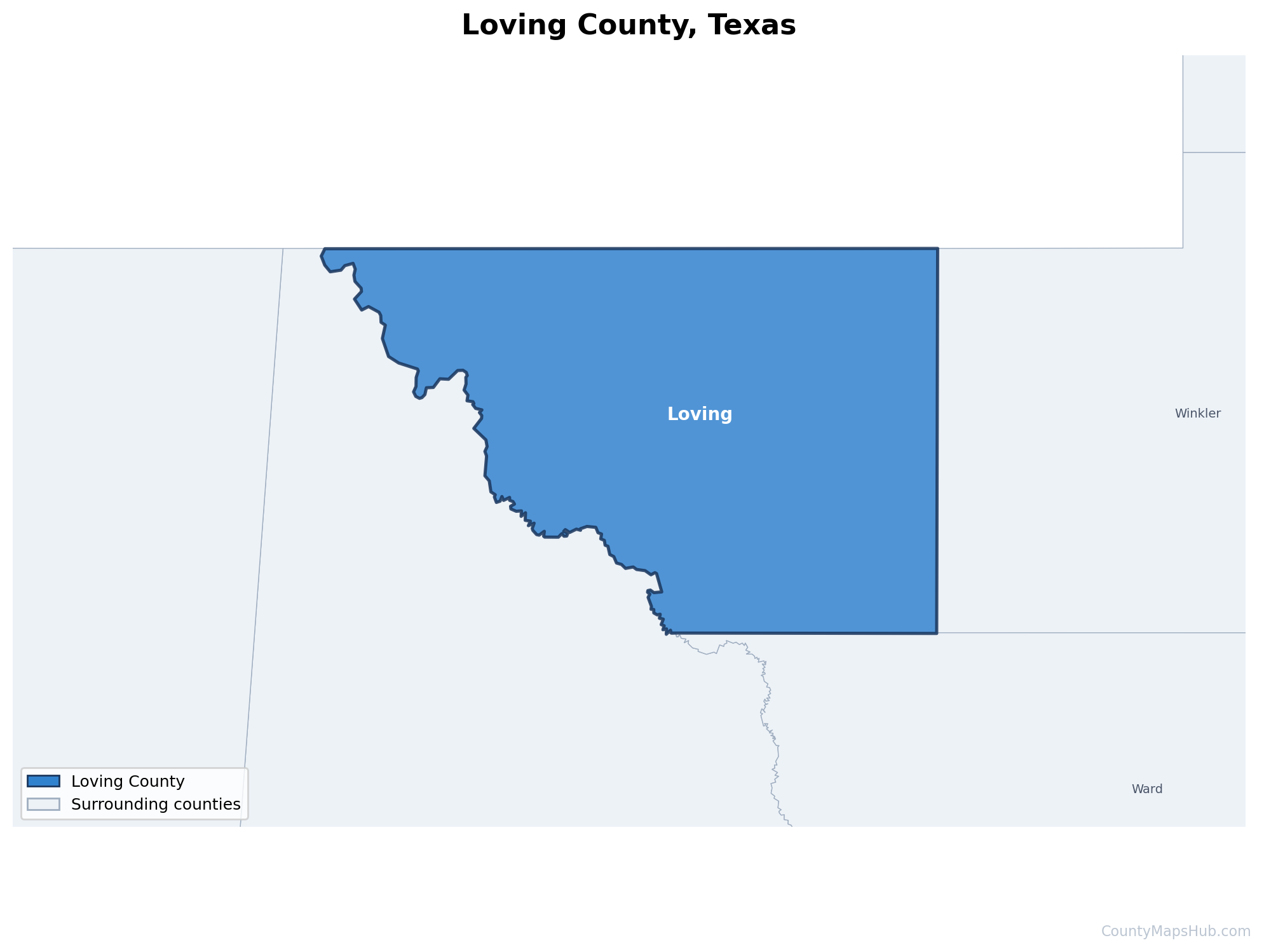
According to the 2020 census, Loving County has a population of just 64 residents, making it the least populated county in the entire United States. This remarkably small population is distributed across 673 square miles, resulting in an extraordinary population density that reflects the challenges of living in this remote desert environment. The county’s tiny population consists primarily of ranching families and those employed in local government and services necessary to maintain county operations. Despite its minimal population, Loving County maintains full county governance with Mentone serving as the county seat, demonstrating the resilience of frontier communities in modern America.
Climate
Loving County experiences an arid climate typical of the Trans-Pecos region of far West Texas. The area is characterized by low annual precipitation, high temperatures during summer months, and mild winters with occasional cold fronts. The desert environment features intense sunshine throughout most of the year, with hot, dry conditions prevailing from late spring through early fall.
The arid climate significantly influences both the natural landscape and human activities in the region. Vegetation is sparse and adapted to drought conditions, consisting primarily of desert shrubs, grasses, and hardy plant species. Water scarcity has historically been a defining factor in settlement patterns and economic activities, with ranching operations adapted to the challenging environmental conditions of this remote corner of Texas.
Tourist Attractions
Loving County offers visitors a unique opportunity to experience one of America’s most remote and sparsely populated regions. The vast desert landscapes provide a stark beauty characterized by open horizons, clear night skies ideal for stargazing, and a sense of isolation increasingly rare in modern America. Those interested in the authentic character of the American Southwest can explore the rugged terrain and witness the enduring legacy of ranching culture in an environment largely unchanged by development.
The county’s extreme remoteness and minimal population create an unusual destination for travelers seeking solitude and a glimpse into frontier life. While visitor services are extremely limited, the area appeals to adventurous travelers interested in desert landscapes, western history, and the experience of visiting America’s least populated county. The surrounding West Texas region offers opportunities for understanding the challenges and rewards of life in one of the nation’s most isolated areas.
Culture
The culture of Loving County is defined by ranching heritage, self-reliance, and the close-knit bonds necessary for survival in an isolated environment. With such a small population, residents maintain strong connections with one another and often with neighboring communities in the broader West Texas region. The ranching tradition remains central to local identity, reflecting values of hard work, independence, and adaptation to challenging conditions that have characterized the area since its settlement.
Life in Loving County represents a distinctive chapter in Texas culture, where the frontier spirit persists in contemporary form. The minimal population and vast distances create a lifestyle markedly different from urban or even typical rural American communities. Local governance operates on an intimate scale, and residents often fulfill multiple community roles. This unique social structure preserves aspects of 19th-century frontier life while navigating the realities of 21st-century America, making the county a living testament to the diverse experiences that comprise the American West.