Atascosa County
About
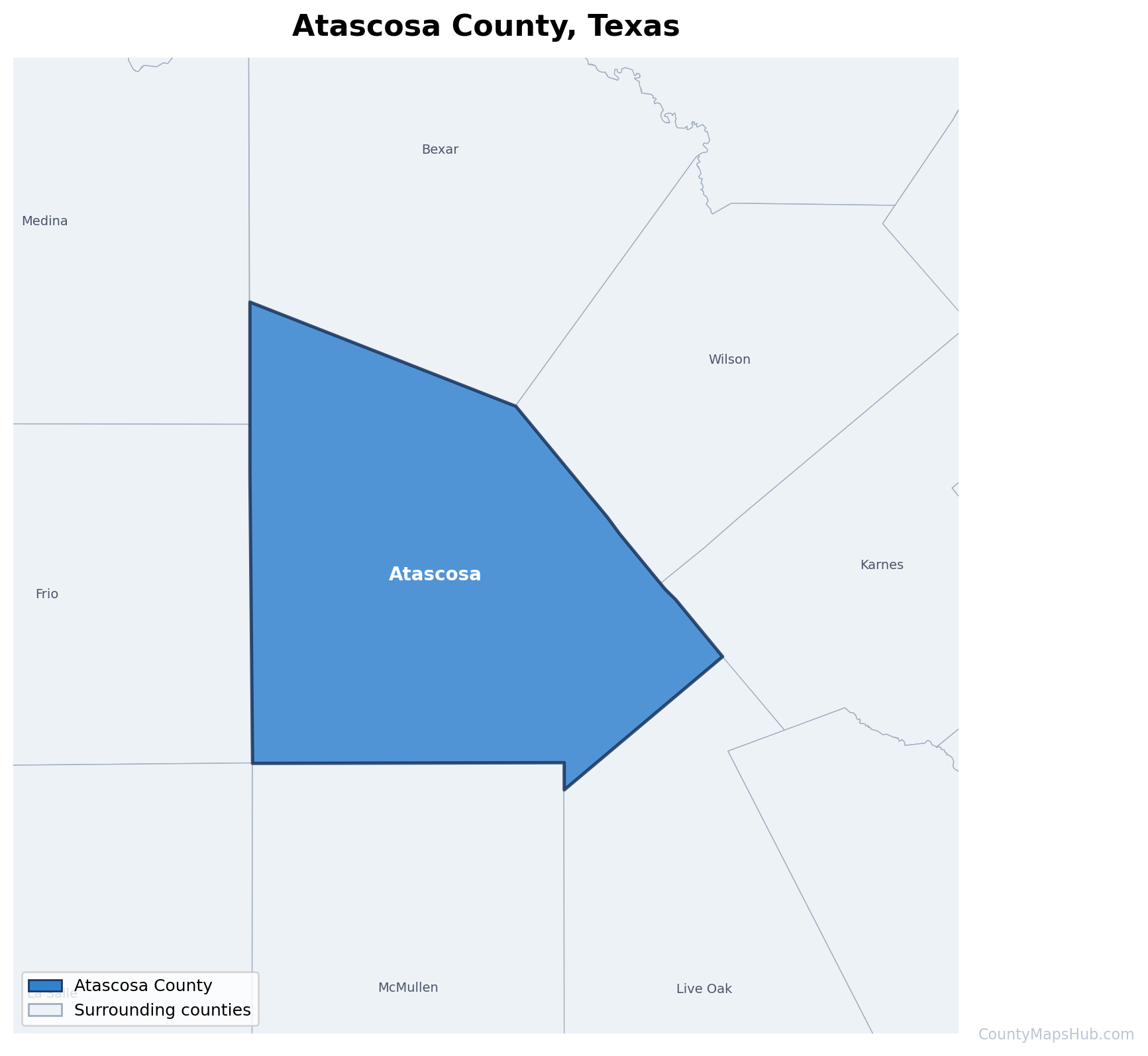
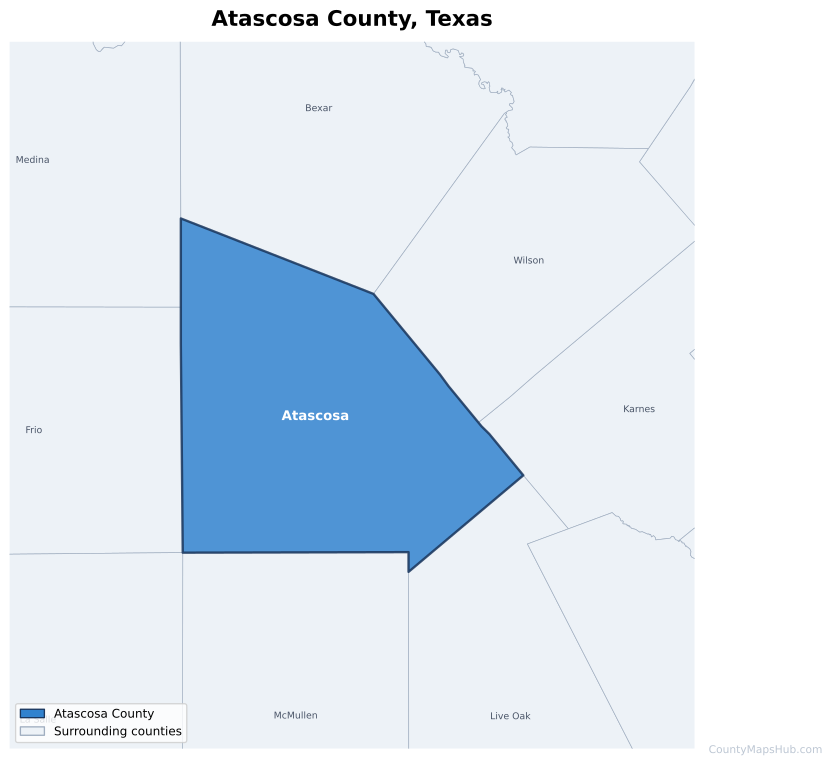
Atascosa County was established in 1856 in the South Texas region, taking its name from the Atascosa River that flows through the area. The county’s formation came during a period of significant growth and settlement in Texas, following statehood and preceding the Civil War. Jourdanton serves as the county seat, providing administrative and judicial functions for the region.
Throughout its history, the county has been shaped by its position in South Texas, experiencing the various waves of settlement, ranching expansion, and agricultural development that characterized the region. The area’s evolution reflects broader patterns of Texas history, including the influences of Spanish colonial heritage, Mexican independence, the Texas Republic, and subsequent American statehood. Over more than a century and a half, the county has maintained its agricultural roots while adapting to changing economic conditions and demographics.
Population
According to the 2020 census, Atascosa County had a population of 48,981 residents spread across its 1,232 square miles. This population density reflects the county’s character as a region that balances rural landscapes with more concentrated settlement areas. The county seat of Jourdanton serves as a focal point for government services and community activities. The population distribution across the county creates a mix of small-town atmosphere and open spaces typical of South Texas counties, where residents maintain connections to both agricultural traditions and modern suburban influences from nearby urban centers.
Climate
Atascosa County experiences a humid subtropical climate, characterized by hot summers and mild winters typical of the South Texas region. This climate zone brings warm temperatures for much of the year, with summer months often reaching high temperatures and significant humidity levels. Rainfall occurs throughout the year, though patterns can vary seasonally, supporting the area’s agricultural activities and natural vegetation.
The humid subtropical conditions create a long growing season that has historically supported ranching and farming operations. Winters are generally short and mild, with freezing temperatures occurring infrequently. The climate contributes to the region’s ecological character, supporting grasslands, brush country vegetation, and riparian areas along waterways. Residents and visitors should be prepared for the heat and humidity during summer months while enjoying the generally pleasant conditions during fall, winter, and spring.
Tourist Attractions
Atascosa County offers visitors an authentic South Texas experience with opportunities to explore the region’s natural landscapes and rural character. The county’s geography includes rolling terrain, brush country vegetation, and waterways that provide settings for outdoor recreation such as hunting, fishing, and wildlife observation. The area’s position in South Texas makes it accessible to those interested in experiencing the distinctive ecology and landscapes of this part of the state.
Visitors interested in small-town Texas culture will find the county seat of Jourdanton and surrounding communities offer glimpses into rural life and local traditions. The region’s agricultural heritage remains visible in working ranches and farmland that dot the countryside. Those exploring the area can experience the slower pace and community-oriented atmosphere characteristic of rural Texas counties, while still being within reasonable distance of larger urban amenities in the broader South Texas region.
Culture
Atascosa County’s cultural identity is deeply rooted in South Texas traditions, reflecting a heritage that blends influences from Spanish colonial history, Mexican culture, and American frontier settlement. The region’s ranching legacy continues to shape local values and lifestyle, with rodeo culture, cowboy traditions, and livestock raising remaining important to community identity. This agricultural foundation contributes to a culture that values hard work, land stewardship, and neighborly cooperation.
The county’s population reflects the broader demographic patterns of South Texas, where Hispanic cultural influences are prominent in local customs, cuisine, and community celebrations. Family ties and multigenerational connections to the land characterize many residents’ relationships with the area. Community events and gatherings throughout the year bring residents together, maintaining social bonds in a region where distances between neighbors can be significant. The cultural landscape represents a continuation of traditions that have developed over generations while adapting to contemporary rural Texas life.